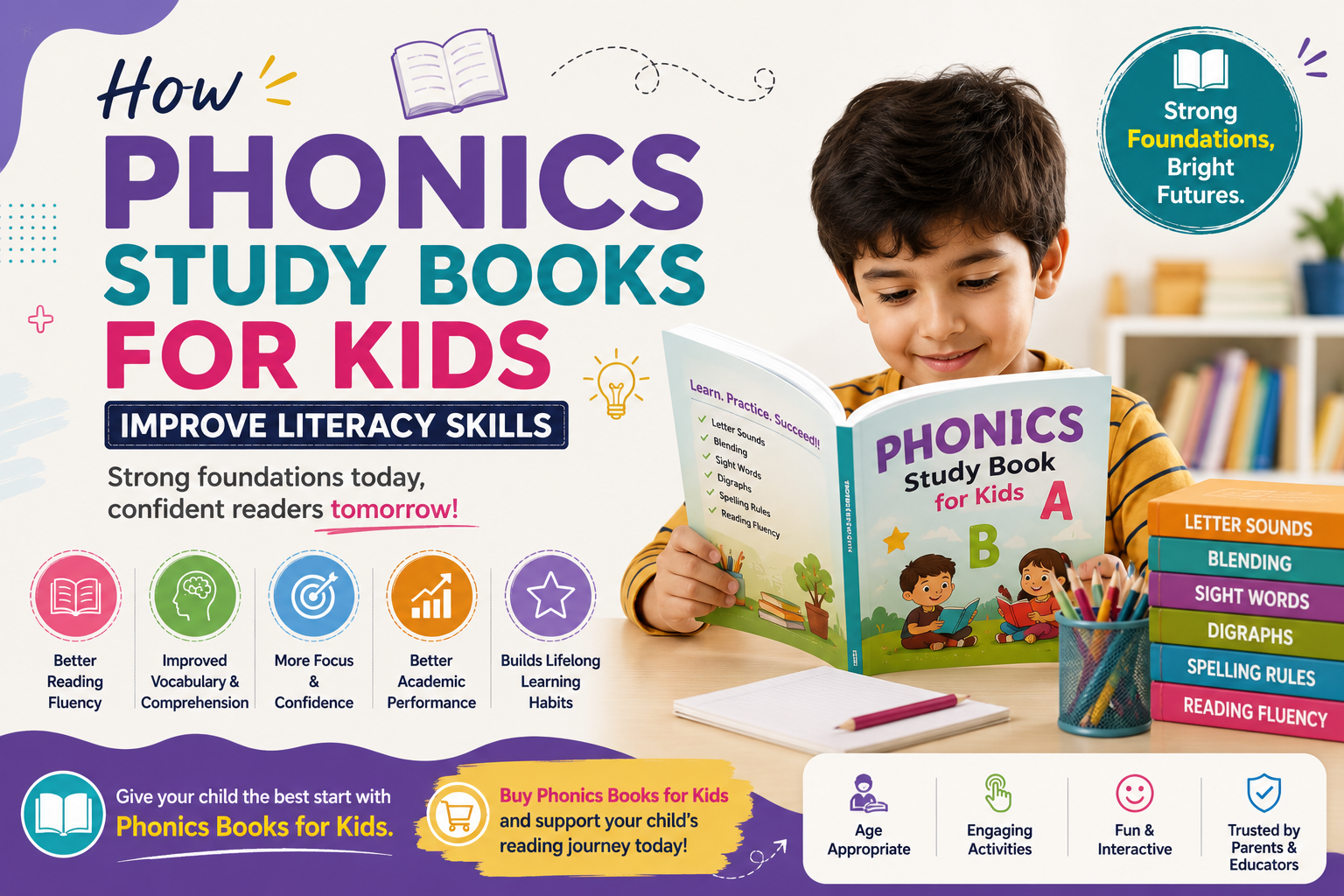
Reading is a skill that children develop early in life that is one of the most important skills. Practising with Phonics Books for Kids increases vocabulary, pronunciation and comprehension. For parents seeking to purchase children’s reading books, they should choose the books that are suitable for their age and that are interesting.
The Hook:
We shouldn’t teach great books; we should generate a love for reading in early literacy years. Literacy is a journey, not a race. Early learning becomes fun-filled when children discover the joy of sounds, letters and words. Strong reading skills start with the strong and rigid foundation. With this vision in mind and the zeal of creating fluent and confident readers, Omega Parkashan has designed the Balvatika workbooks. Thoughtfully designed by the practitioners, these workbooks offer a wide range of engaging fun and interactive activities. They are carefully and minutely designed and prepared on a highly research- based approach and age-appropriate curriculum. Dive in to have a clearer view of this unique program and to give your child a perfect start.
The Backstory:
Have you ever watched your child look at a simple three-letter word, hesitate and then guess a completely wrong word based just on a picture next to it? Reports such as ASER highlight that children struggle with even the basic reading skills like, identifying sounds, blending letters, reading and understanding simple texts. Children must learn the basic and foundational concepts to bridge these learning gaps. This is where the role of a structured and graded phonics program comes into practice and becomes relevant. This growing concern ignited the need for a well-furnished program that could cater the basic needs of the children.
The Need of Phonics Workbooks/ Books:
The struggle of reading at different stages signaled a strong need to develop books that could help kids master the basic rules of phonics in a graded way so that we could produce fluent readers. Reading is not only an academic skill but is a life skill. Phonics books provide a structured, graded and well-defined way for children to connect letters with sounds. Children must be taught a systematic way to form words.
Phonics enables children to:
- Connect letters with sounds
- Blending and segmenting words
- Improve reading fluency
- Develop vocabulary and comprehension
In the absence of a proper reading program, children often rely on memorization and guess work that hurdles the long-term literacy development.
Why is reading so important?
Reading is essential for those who want to rise above the ordinary. It is a basic tool in living of a good life. It is a most important tool to strengthen vocabulary, communication, comprehension and imagination.
Fluent reading helps in various ways like:
- Building concentration and focus
- Enhancing creativity and thinking skills
- Developing confidence and creativity
- Overall improvement in academic performance
Strong foundation leads to stronger buildings. Similarly strong mastery over skills leads to stronger and brighter future.
What are Phonics Books for Kids?
Phonics books for kids are specially designed learning tools and educational resources that help children master phonics rules. By using simple words, catchy pictures and interactive activities, these books help children to get engaged and learn deeper focusing on concept development. They drive the child away from rote memorization towards understanding the hidden concepts.
During Foundational years (ages 3-8), children need to have a systematic approach and a proper planned structure to reading. Parents start teaching them ‘A for apple’ or drive kids towards memorization of the whole words. Memorization simply cannot scale. Here is when phonics books become the ultimate game-changer for the child’s literacy journey.
Phonics books usually focus on:
- Letter sounds and sound recognition
- Blending sounds to form words
- Pronunciation and spelling rules
- Digraphs/ trigraphs and blends
- Reading fluency and comprehension
These books help children become more confident readers making early literacy even more effective from a very early age.
What exactly is Phonics?
Phonics is a method of correlating sounds with letters or groups of letters. While the English alphabet has 26 letters, those letters create 44 unique sounds (phonemes).
Phonics books teach children to decode text instead of guessing a word. Children learn to break words and blend them together:
C (/k/) + A (/æ/) + T (/t/) = Cat
Why are Phonics Books important?
1. Builds Strong Reading Foundation
Phonics books enable students to develop strong letters – sound connection. This is the core concept of reading. This connection helps them to decode new words rather than memorizing everything.
2. Supports Logical Progression of Skills
These books follow a proper, graded and age-appropriate progression that helps to master concepts step by step.
Sounds – Blending – Sight Words – Sound blends – Digrahs – Trigraphs – Split digraphs – Spelling rules
This progression prevents confusion and makes reading feel like a skill rather than memorizing stuff.
3. Reinforces Learning through Practice
Workbooks offer many activities that help children in spiral learning to help them master the concept. This active engagement strengthens memory unlike passive listening that is only a non – interactive, one way instruction pathway.
4. Balances Decoding and Fluency with Sight Words
Sight words help children read common words that don’t always follow phonics rules. This balance:
- Improves reading speed and fluency
- Reduces frustration
- Keeps reading enjoyable and meaningful
5. Makes Spelling Rules Clear and Predictable
Spelling rules help children understand why words are spelled the way they are—rather than relying on guesswork. They improve spelling accuracy and writing skills.
6. Supports Multiple Learning Styles
A good workbook combines different learning:
- Visual cues (pictures)
- Auditory practice (say-the-sound activities)
- Kinesthetic tasks (writing, tracing, circling)
This multi-sensory approach is effective in early years and supports all children with different learning needs.
7. Builds Confidence and Independence
Children feel a sense of success and victory when they are able to read flawlessly. This fills them with confidence, independence and self-esteem that generate a natural love for reading in kids. They get motivated and have a positive attitude towards learning.
8. Helps Teachers and Parents Track Progress
The workbooks are a useful resource to track the milestones achieved in the learning process. They help to know what a child has mastered and where do they need extra support. This helps in bridging the learning gaps.
11. Eliminates the ‘Guessing’ Habit
Decodable phonics Study books use letters and sounds. The child shows understanding of what he has already learnt. This helps them to follow the actual reading rules rather than guesswork.
12. Accelerates Spelling and Writing
A child who learns to decode a word phonetically can also encode it (spell it out). Phonics reading books teach the structural patterns which help the children to encode and frame spellings thus reducing the spelling errors.
13. Equitable Learning Opportunities
Books provide a structured and an easily approachable learning tool. It can support children regardless of background and impart quality literacy to all the children.
Features of good Phonics Books
A good phonics book for kids makes learning sounds and reading feel natural, fun-filled, and progressive. It should focus on some of the features that can help its readers draw maximum benefit out of it.
1. Clear focus on phonics progression
It should follow a structured sequence—starting from simple letter sounds and gradually moving to blends, digraphs and other graded concepts. These books must follow a proper progression avoiding anything abruptly appearing in between.
2. Strong sound–letter connection
Every page should aid in making the letter – sound connection deeper. They must gradually learn to link spoken sounds with written letters.
3. Decodable text
Proper care must be taken to use the words that are easily decodable. Children should be able to read them using the phonics rules. This builds confidence and eliminates guessing.
4. Supportive illustrations
Pictures should clearly support the text so children can confirm meaning. But the picture illustrations must not be such that they promote guess work.
5. Step-by-step difficulty levels
A good phonics series should be graded and leveled. This helps the parents and teachers to identify the learning gaps and to rule them out.
6. Interactive elements
A good phonics book for kids must include interactive material and activities that support and reinforce learning like:
- blending practice using flashcards
- “find the word”, “segment the word” tasks
- tracing letters
- Matching beginning/ middle/ ending sounds to pictures
9. Read-aloud tasks
The books must contain age-appropriate reading text that helps children develop interest and love for independent reading. These exercises also focus on better pronunciation and fluency.
11. Reinforcement of sight words (gradually)
Along with the phonics words, children must be introduced to the sight words. Sight words greatly help to develop reading fluency and accuracy.
12. Encourages confidence and independence
The best phonics books should help children gain confidence towards reading. They should enable children to feel a sense of achievement.
13. Progressive Phonics Learning Pathway
Phonics books must follow a graded, structured and progressive pathway so as to keep children at ease. They must also follow an age appropriate progression to help the kids learn in alignment to how their brain grows and works.
Why must parents buy Phonics Books?
Parents buy phonics books because they help in shaping important skills. The clearer the concepts are during early literacy; stronger will be the hold on the language development. Phonics books are the platform that works wonders and can be a game – changer.
1. They build the foundation of reading
Phonics books teach children the connection between letters and sounds. Instead of memorizing whole words, kids learn the techniques of blending and then decoding the words.
2. They reduce dependence on memorization
Without phonics, children memorize either the shapes of the words or entirely depend upon the guess work. Phonics books help them decode unfamiliar words step by step, which is more beneficial during the later years.
3. They improve reading confidence
Phonics books are graded and leveled and so they act as a tool to enhance the confidence for independent reading in young learners. They feel motivated and reinforced to pick up different texts and read naturally.
4. They strengthen pronunciation and spelling
When kids learn the letter sounds and are aware of how to blend and segment words, they are competent to frame and speak new spellings. Reading and spelling formation develop together.
5. They support structured learning at home
Parents are able to get the clearly defined instructions and need not get confused or be trained before taking up their kids. Adults can easily guide children by following proper steps.
6. They bridge the gap between speaking and reading
Children learn to speak before they learn to read. Phonics helps connect familiar spoken language to the written text in a logical and easy way.
7. They make early reading less frustrating
When children are given age – appropriate and progressive content, they experience fewer failures and so develop less negativity.
9. They prepare kids for school success
Strong early reading skills are beneficial in the further learning journey of young learners. It helps children exhibit better understanding and fosters better performance.
How Teachers use Phonics Books in Classrooms?
Phonics books help in making the classroom more interactive by involving kids in child friendly activities. They enable to make teaching an active process rather than being passive. Students learn step by step along with an age friendly curriculum. They enhance participation and encourage children to enjoy learning.
Classroom Activities with Phonics Books
Teaching sounds: Sound recognition games enabling letter-sound correspondence.
Decodable reading practice: Reading aloud sessions.
Letter and Sound matching exercises
Small group learning: Reading words and story reading practice.
Reinforcement activities: Find sounds, highlight letters, and picture identification activities.
Tips for Helping Kids Learn Phonics Faster
- Teach one sound at a time: Too many letters or sounds must not be taught together.
- Practice daily: Short, regular sessions for repetition work best.
- Use sound games: Rhyming, matching, and “I spy” with sounds make learning fun.
- Focus on blending early: Teach children to join sounds to form words.
- Read decodable books: Only those books should be preferred that offer decodable text according to each level. Use words that match the regular sounds that they already know.
- Repeat often: Repetition helps to gain confidence, better understanding and memory.
- Use actions and visuals: Hand movements or pictures help link sounds to letters. Flash cards can also be used as visual aids.
- Encourage speaking aloud: Kids should be encouraged to read aloud.
- Correct gently: Mistakes should be corrected without discouraging the child.
- Make it playful: Songs, flashcards, and games keep kids engaged for longer.
Why Choose Omega Parkashan for Phonics Books?
“These books are designed in the right direction as they are prepared by expert practitioners who are well aware of the diverse needs of children. They are prepared in a graded and systematic manner. These workbooks are prepared on a research-based approach that clearly defines a need to have a systematic system to enhance student learning. They are helpful in driving the child away from rote memorization method to a completely skill based approach. Each topic is systematically arranged and the books follow a graded pattern catering the needs suitable for a particular age group. The content is presented in such a way that it completely matches the interests of the young learners. Some key features of Omega Parkashan workbooks are as follows:
1. Skills are fragmented into simple manageable steps
Instead of presenting reading as a complicated task, these books are divided into small fragments that match the needs of that particular age group. Chunking reduces burden and fosters efficiency.
2. One concept at a time
These books cover one topic at a time enabling mastery over each concept rather than rushing ahead just for completion. Each topic is clearly explained and exhibits reduced burden and confusion for teachers and students.
3. Clear patterns replace guesswork
Each concept is clearly explained in these workbooks that leads the child away from guess work. They get a clear explanation of every detail which drives them away from guessing or memorizing.
4. Purposeful repetition
Each concept has purposeful repetition and does not make it vague. Repetition is made for spiral learning to ensure that the kids could connect the previous knowledge to the newly learnt concepts. This helps learning feel smoother and natural.
5. Visuals support scaffold learning
The picture illustrations, examples and guided prompts act as an additional support to enhance learning. Children are not left behind to struggle rather they are slowly guided towards learning. This learning also encourages independence.
6. Immediate application
Children are made to apply each concept which ensures understanding. It generates confidence among young learners that keeps them away from anxiety. They feel learning is easier when they are not confused with concepts.
7. Progression leads to confidence
Success at small steps make the children feel capable and gradually they get drifted towards learning. They willingly get attracted towards trying on new challenges that creates fun and excitement.
8. Prepared by practitioners
The key feature of these books is that they are prepared by the expert classroom practitioners, who are well aware of the everyday challenges and the strategies to overcome them. They have carefully planned each concept considering the ground level to derive positive results and quick fix the challenges. Learning has been simplified in these books to enhance better learning.
Conclusion
In conclusion, phonics is the key to unlocking a brighter future. It fosters skill development and builds a stronger and deeper understanding leading to a strong foundational beginning. Simple and consistent methods, regular repetition, sound games, activities and constant guidance make learning an interesting tale rather than just being a classroom affair.
To support your child’s this literacy journey, now is the perfect time to navigate them. More than just words on a page, gift your child the secret to a smoother learning, Phonics Books for kids by Omega Parkashan. These books are a perfect balance of education and entertainment for young and curious minds. Help them early vocabulary and phonics while keeping the giggles alive.
Order now and begin your child’s confident journey.